

Research Pillar 02
Condition Monitoring of Mechanical Systems
Intelligent methods for monitoring, diagnosing, and predicting the condition of mechanical systems, vehicles, rotating machinery, and complex engineering assets.
The field
What it means
Condition Monitoring involves the continuous, periodic or on-demand assessment of machinery health monitoring using vibration measurements and operational data. It enables early fault detection, diagnosis, severity assessment and Remaining Useful Life (RUL) estimation, providing the basis for informed maintenance decisions and Predictive Maintenance.
The challenge
Why reliable monitoring is difficult
Varying EOCs
Environmental and operational variability can alter vibration signal characteristics and mask the effects of faults, making robust fault diagnosis particularly challenging.

Complex mixed spectra
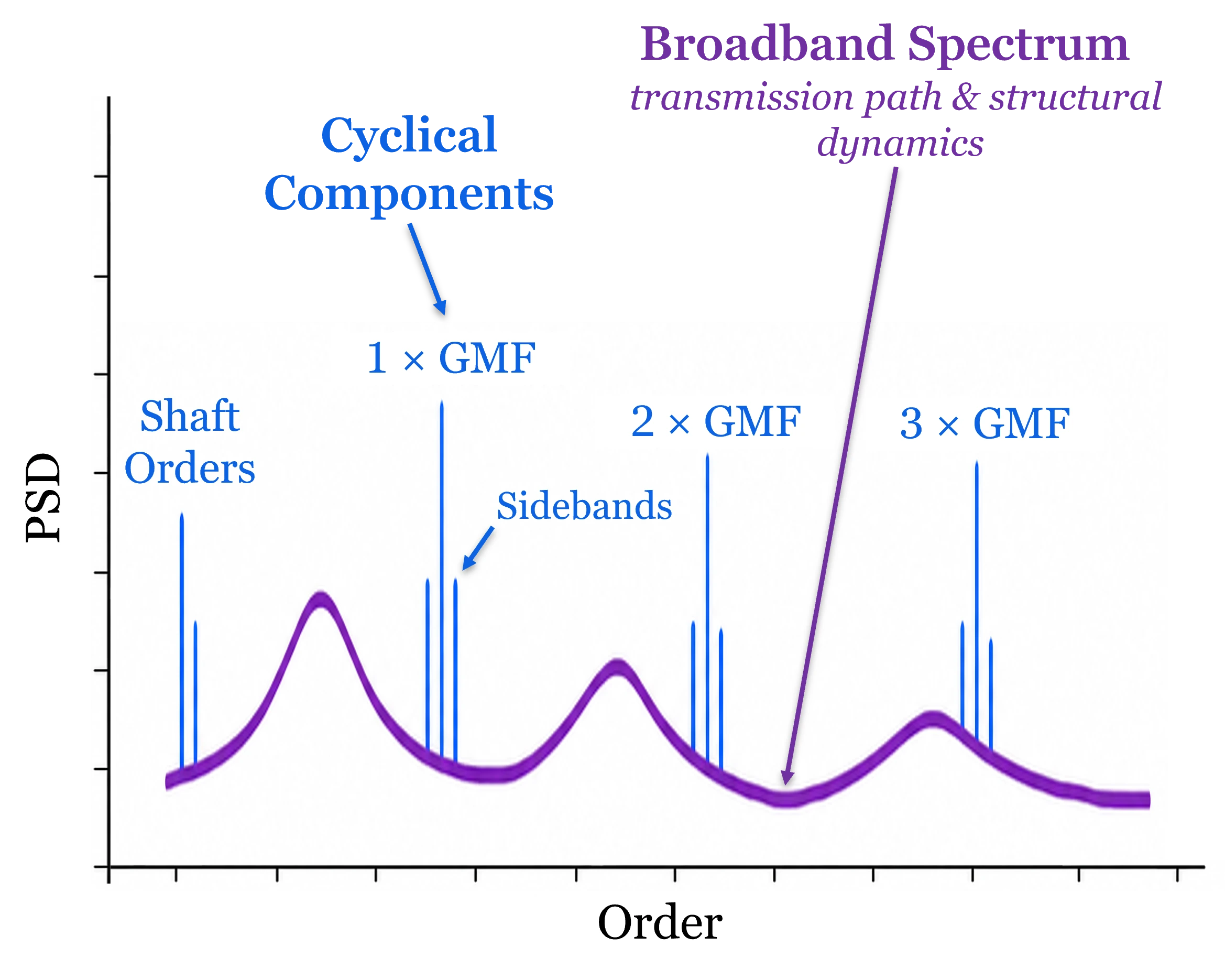
Complex machinery vibration signals may contain shaft and gear-meshing harmonics, modulation-induced sidebands, and broadband stochastic components from transmission paths and structural dynamics, requiring specialized stochastic parametric modelling for accurate dynamic identification and fault diagnosis.
Limited faulty-state signals
Faulty-state measurements from industrial systems are scarce making supervised learning particularly demanding.

SMSA Laboratory
Where SMSA stands
SMSA develops robust, physically interpretable Condition Monitoring methods for machinery operating under uncertainty and varying conditions. By combining vibration-based analysis, stochastic system identification, statistical time-series models, and Machine Learning, these methods support reliable fault detection, diagnosis, severity assessment, and Remaining Useful Life estimation.
+
Prediction Error (PE) methods for dynamic identification
+
Statistical time-series methods for fault diagnosis
+
Machine Learning methods for fault diagnosis
+
Robust monitoring under varying operating conditions
+
Advanced modelling of mixed spectral components and cyclostationarity
+
Surrogate modelling for high fidelity damaged-state signal generation
+
Functional and varying-parameter models
+
Numerical, laboratory and real-world validation
From sensing to reliable condition assessment.
Applications
Engineering domains
Rotating machinery and drivetrains
Industrial and manufacturing systems
Transportation and propulsion systems
Energy and power systems
Continue exploring